搜索

x

留言板

姓名
邮箱
手机号码
标题
留言内容
验证码

引用本文:
Citation:

潘文雁, 程传勇, 牛菁菁, 元冰, 杨恺, 董雪薇
cstr: 32037.14.aps.74.20250616

Molecular dynamic simulation study on co-aggregation between amyloid-β and Medin

PAN Wenyan, CHENG Chuanyong, NIU Jingjing, YUAN Bing, YANG Kai, DONG Xuewei
cstr: 32037.14.aps.74.20250616
Article Text (iFLYTEK Translation)
PDF
HTML
导出引用
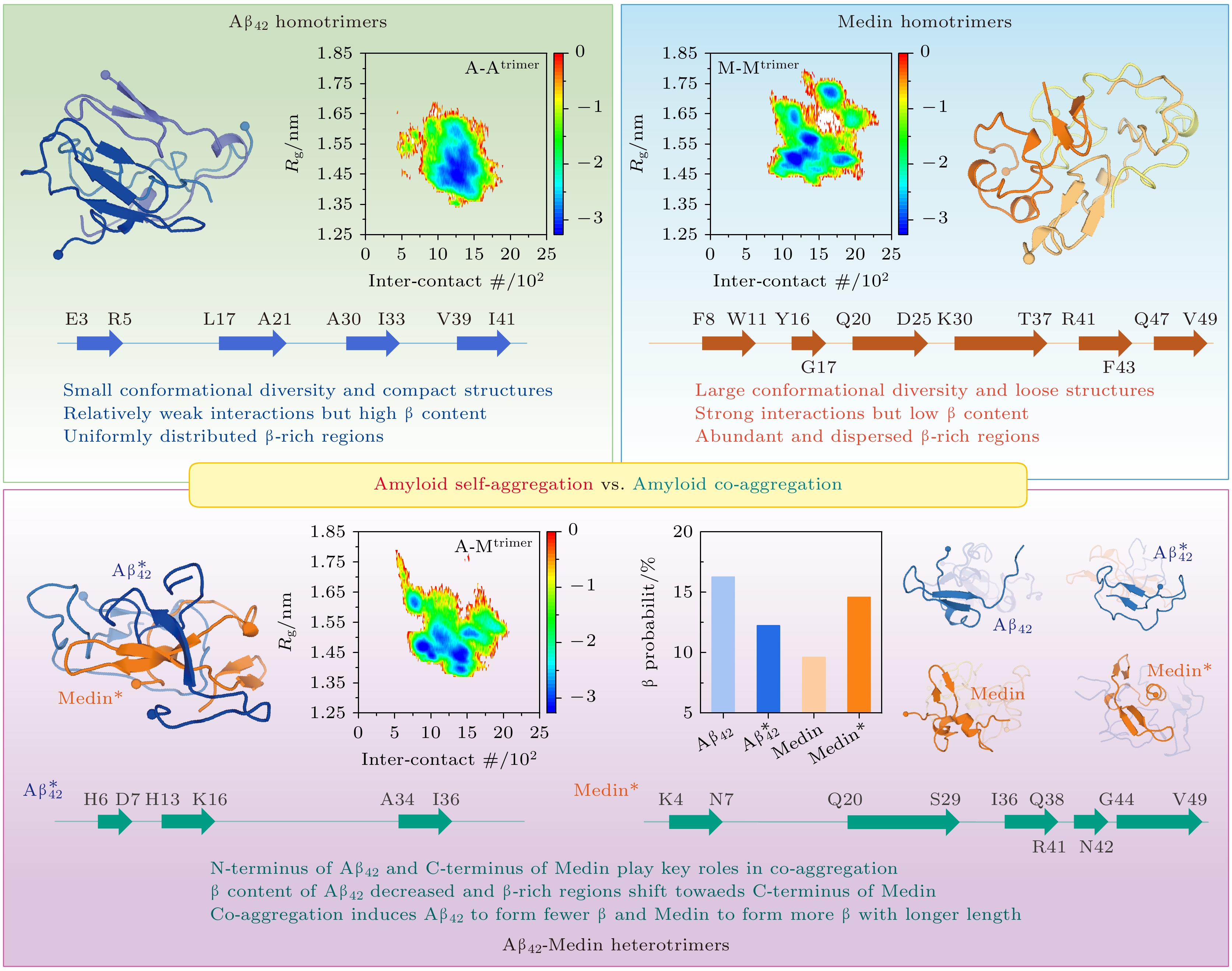
  • Medin淀粉样蛋白的聚集导致动脉壁退化和脑血管功能障碍, 参与多种血管疾病的发生与发展. 在血管性痴呆或阿尔茨海默病患者的脑小动脉中发现Medin聚集体增加, 且Medin与血管β-淀粉样蛋白(Aβ)沉积物共定位. 实验证实Medin能够与Aβ共同形成异源纤维, 并通过交叉接种机制调控Aβ的聚集. 然而, Medin与Aβ共聚集的微观机制仍不清楚. 本文利用大规模的全原子副本交换分子动力学模拟(累计模拟时间72 μs), 对Aβ42与Medin三聚体在不同多肽环境(即自聚集vs.共聚集)的相互作用及构象分布进行了研究. 结果表明, Aβ42与Medin的亲和力更高, Aβ42与Medin在自身或彼此结合时具有相似的分子识别位点或区域, 为共聚集提供基础. Aβ42的N端与Medin的C端在Aβ42-Medin交叉聚集中起到关键作用. 更重要的是, 共聚集显著地改变了Aβ42与Medin的相互作用强度、方式以及结构特征. Aβ42-Medin三聚体中, Aβ42分子间相互作用减弱, 仅保留疏水核心区域(16KLVFFA21)之间的结合而提高其他区域的自由度; Medin形成更多的β结构与更少的helix结构, 但Aβ42却形成更多的helix与更少的β; 而Medin中高β倾向性区域向肽链中部和C端迁移, 表明Medin可能通过C端形成β结构作为核心从而驱动其与Aβ42的协同聚集. 本工作在原子水平上详尽地阐明了共聚集对Aβ42与Medin相互作用与结构特征的影响, 为理解Aβ42-Medin共聚集分子机制以及不同疾病之间交叉关联的病理机制提供了有益见解.
    The aggregation of Medin is closely related to the arterial wall degeneration and cerebrovascular dysfunction. In patients with vascular dementia or Alzheimer’s disease, the concentration of medin in cerebral arterioles increases, and Medin is co-localized with vascular amyloid-β (Aβ) deposits. Previous study demonstrates that Medin interacts directly with Aβ, forming heterologous fibrils with Aβ and promoting Aβ aggregation. However, the basic mechanism of the co-aggregation between Medin and Aβ remains largely elusive. Here, we explore the interactions and conformational ensembles of Aβ42/Medin trimers in different peptide environments (self-aggregation vs. co-aggregation) by performing all-atom replica exchange molecular dynamic simulation on Aβ42/Medin homotrimers and Aβ42-Medin heterotrimer with an accumulated simulation time of 72 μs. Our results reveal that Aβ42 exhibits higher affinity with Medin, and Aβ42 and Medin have similar molecular recognition sites in self-aggregation and co-aggregation. The N-terminus of Aβ42 and the C-terminus of Medin play critical roles in Aβ42-Medin cross-talk. More importantly, co-aggregation significantly changes the interaction strength, binding patterns and structural characteristics of Aβ42 and Medin. Intermolecular interactions of Aβ42 trimers are relatively weak among three trimers, and the binding sites are concentrated between N- and N-termini, between N- and C-termini, and between C- and C-termini of Aβ42. In contrast, intermolecular interactions of Medin trimers are the strongest, and the binding sites are widely and uniformly distributed in Medin peptides. Intermolecular interactions of Aβ42 in Aβ42-Medin heterotrimer decrease compared with those of Aβ42 trimers, only the binding of the hydrophobic core regions (16KLVFFA21) is retained and other regions of Aβ42 gain increase flexibility. Two-dimensional free energy landscapes reveal distinct conformational diversities between the homo- and heterotrimers, with the order of diversity being Medin/Aβ42-Medin trimers > Aβ42 trimers. The Rg of Aβ42 trimers is smaller than those of the other two trimers, implying that Aβ42 trimers possess a more compact structure, whereas Medin/Aβ42-Medin trimers exhibit a relatively loose conformation. The Aβ42 trimers possess the highest β content whereas Medin trimers exhibit the lowest β probability. It is found that Aβ42-Medin co-aggregation induces Medin to form more β-structures with longer lengths and fewer helices, while promoting Aβ42 to form more helices and fewer β-structures. High β-propensity regions of Medin in heterotrimers shift towards the C-terminus of Medin, suggesting that Medin utilizes its C-terminal β region as a core motif to drive its co-aggregation with Aβ42. These results elucidate the detailed influences of co-aggregation on the interactions and conformations of Aβ42 and Medin. This work provides key insights into the molecular mechanism of Aβ42-Medin co-aggregation and the pathological mechanisms of cross-linking between related diseases.
      通信作者: 元冰, yuanbing@sslab.org.cn ; 杨恺, yangkai@suda.edu.cn ; 董雪薇, dongxuewei@suda.edu.cn
    • 基金项目: 国家自然科学基金(批准号: 12274307, 32230063, 22303060)、江苏省自然科学基金(批准号: BK20230470)、广东省基础与应用基础研究基金(批准号: 2023A1515011610, 2023B1515120001)和复旦大学应用表面物理国家重点实验室(批准号: KF2023_03)资助的课题.
      Corresponding author: YUAN Bing, yuanbing@sslab.org.cn ; YANG Kai, yangkai@suda.edu.cn ; DONG Xuewei, dongxuewei@suda.edu.cn
    • Funds: Project supported by the National Natural Science Foundation of China (Grant Nos. 12274307, 32230063, 22303060), the Natural Science Foundation of Jiangsu Province, China (Grant No. BK20230470), the Guangdong Basic and Applied Basic Research Foundation, China (Grant Nos. 2023A1515011610, 2023B1515120001), and the Open Research Fund of State Key Laboratory of Surface Physics of Fudan University, China (Grant No. KF2023_03).
    [1]

    [2]

    [3]

    [4]

    [5]

    [6]

    [7]

    [8]

    [9]

    [10]

    [11]

    [12]

    [13]

    [14]

    [15]

    [16]

    [17]

    [18]

    [19]

    [20]

    [21]

    [22]

    [23]

    [24]

    [25]

    [26]

    [27]

    [28]

    [29]

    [30]

    [31]

    [32]

    [33]

    [34]

    [35]

    [36]

    [37]

    [38]

    [39]

    [40]

    [41]

    [42]

    [43]

    [44]

    [45]

    [46]

    [47]

    [48]

    [49]

    [50]

    [51]

    [52]

    [53]

    [54]

    [55]

    [56]

    [57]

    [58]

    [59]

    [60]

    [61]

    [62]

    [63]

    [64]

    [65]

    [66]

    [67]

    [68]

    [69]

    [70]

    [71]

  • Baidu
  • [1]

    [2]

    [3]

    [4]

    [5]

    [6]

    [7]

    [8]

    [9]

    [10]

    [11]

    [12]

    [13]

    [14]

    [15]

    [16]

    [17]

    [18]

    [19]

    [20]

    [21]

    [22]

    [23]

    [24]

    [25]

    [26]

    [27]

    [28]

    [29]

    [30]

    [31]

    [32]

    [33]

    [34]

    [35]

    [36]

    [37]

    [38]

    [39]

    [40]

    [41]

    [42]

    [43]

    [44]

    [45]

    [46]

    [47]

    [48]

    [49]

    [50]

    [51]

    [52]

    [53]

    [54]

    [55]

    [56]

    [57]

    [58]

    [59]

    [60]

    [61]

    [62]

    [63]

    [64]

    [65]

    [66]

    [67]

    [68]

    [69]

    [70]

    [71]

计量
  • 文章访问数:  825
  • PDF下载量:  58
  • 被引次数: 0
出版历程
  • 收稿日期:  2025-05-11
  • 修回日期:  2025-05-18
  • 上网日期:  2025-06-04
  • 刊出日期:  2025-08-05

返回文章
返回
Baidu
map