













-
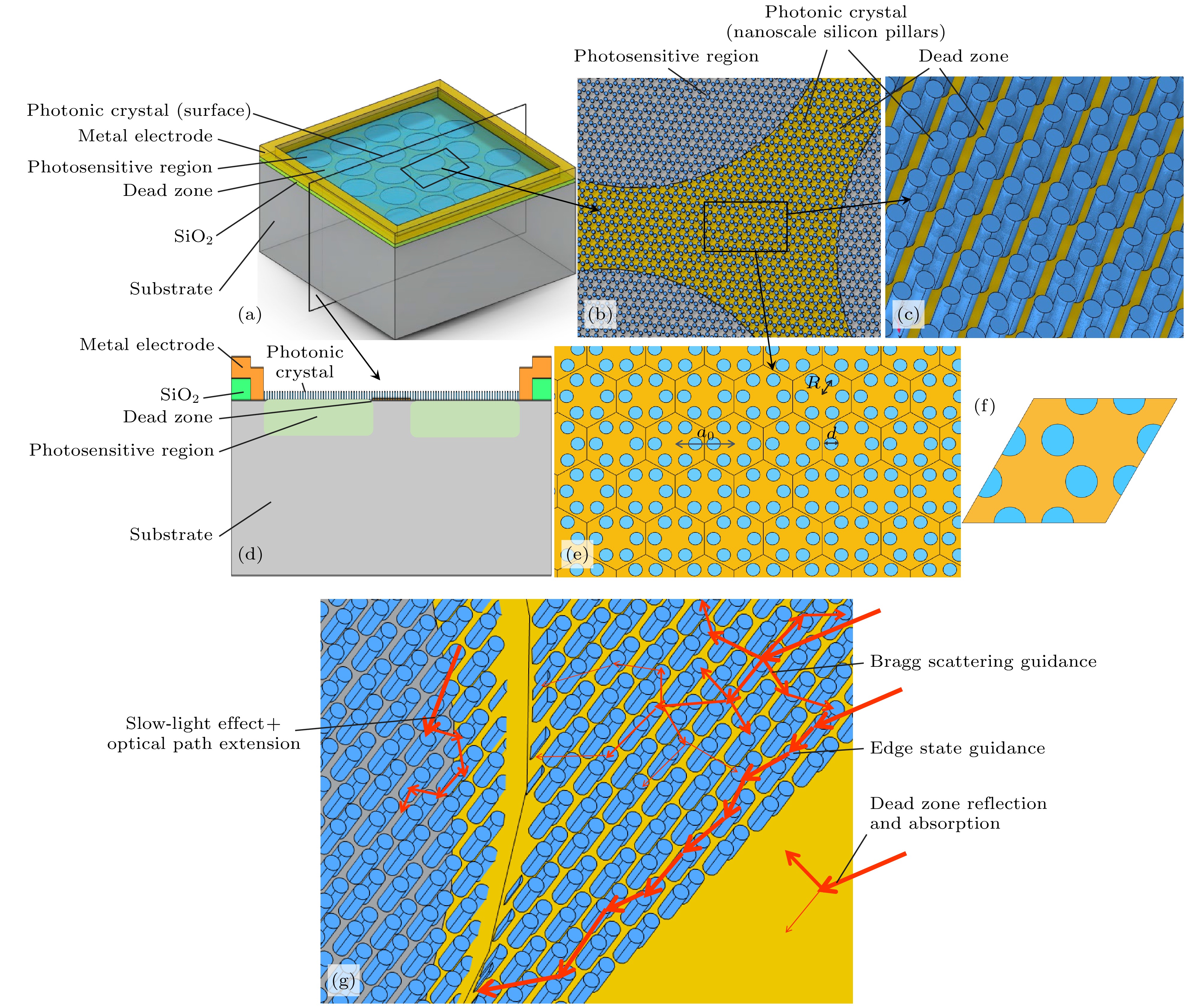
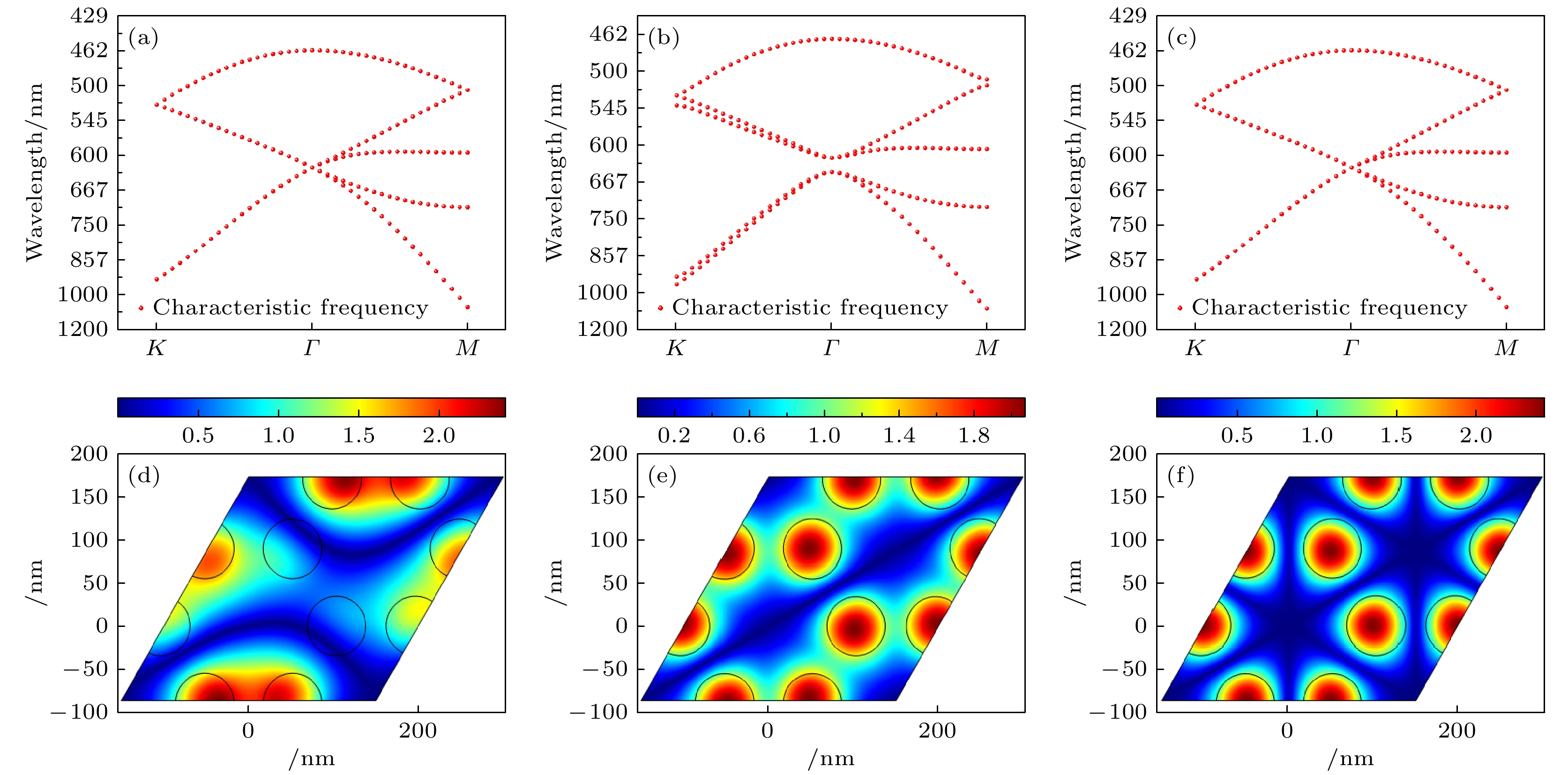
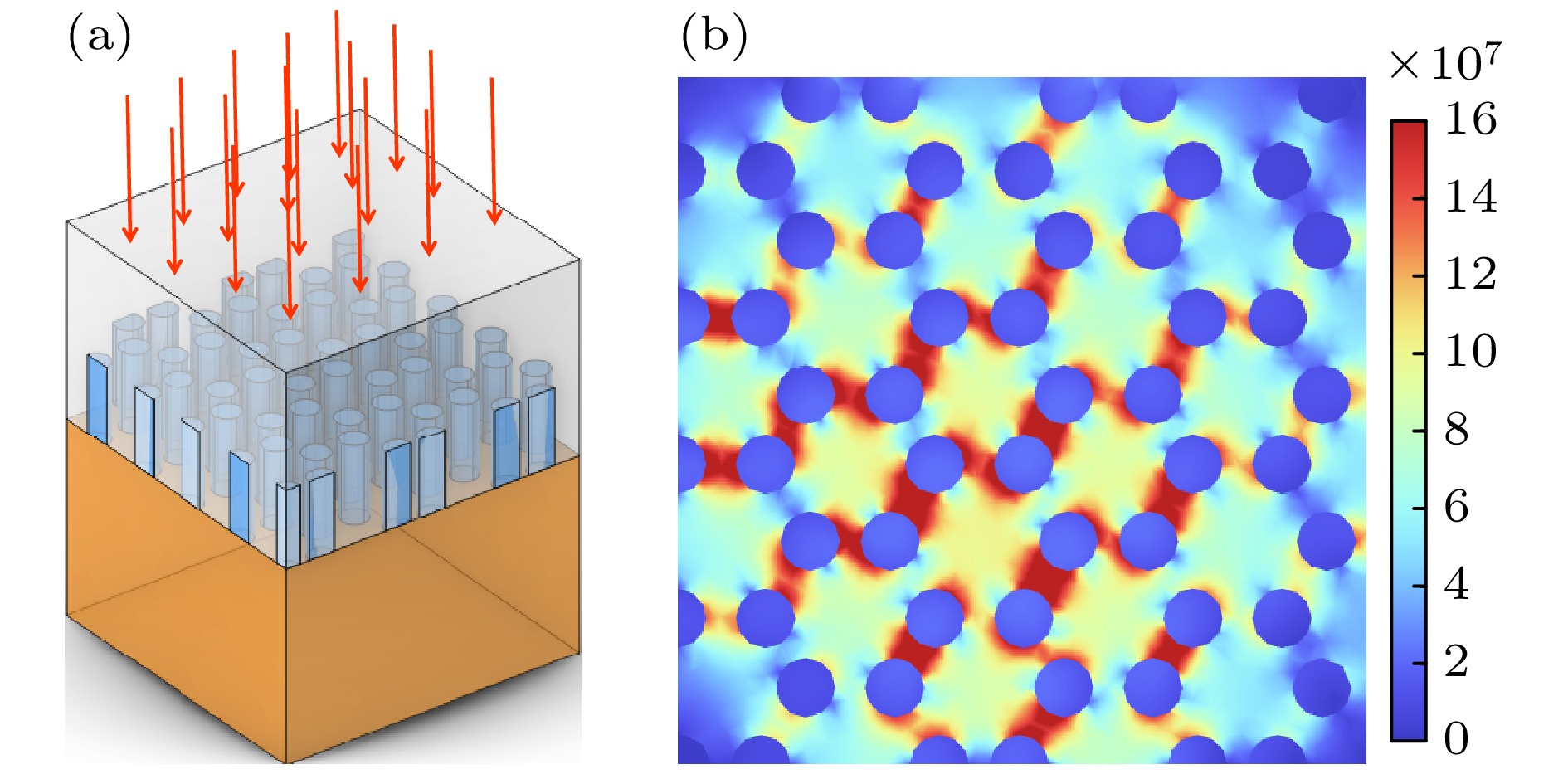
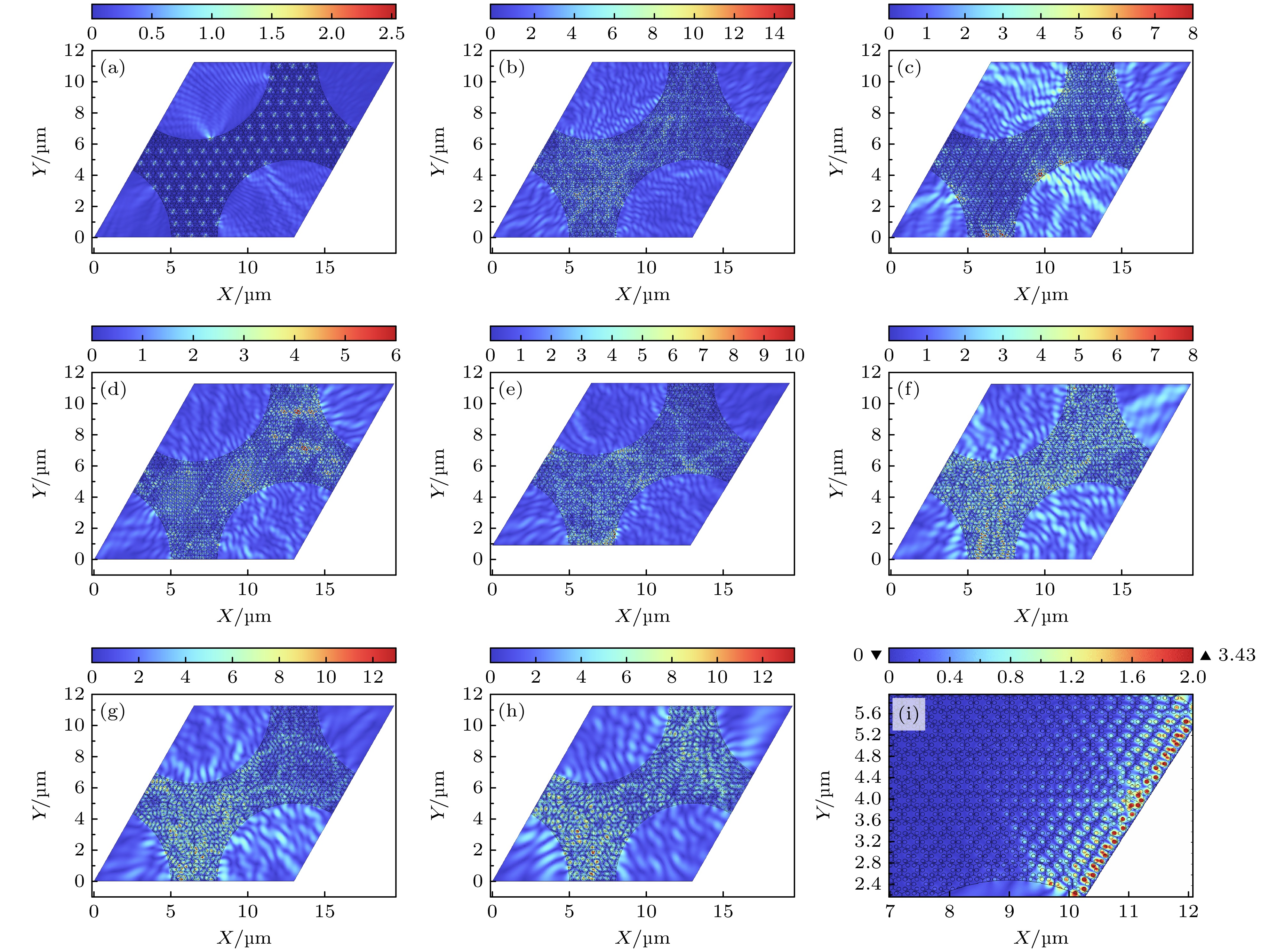
硅光电倍增管(SiPM)在微弱光探测领域已获得广泛应用. 然而基于小尺寸G-APD单元的SiPM存在有效几何填充因子(GFF)受限问题, 使其光子探测效率(PDE)相对较低. 此外, 受硅材料本征特性制约, 其在近红外波段的PDE亦相对不足. 针对上述问题, 本文提出一种基于拓扑光子晶体(TPC)的分区域光场调控方案, 旨在不改变SiPM内部结构的前提下提升其PDE. 通过COMSOL电磁波频域仿真, 揭示了死区拓扑边缘态引导、光敏区慢光效应及布拉格散射的多波段协同机制: 在460—700 nm波段, 死区蜂窝晶格通过Floquet周期性分析诱导拓扑边缘态, 同时利用晶格周期性介电分布激发布拉格散射, 减少光子在金属表面的反射损耗, 将光子精准耦合至光敏区, 其在621 nm处的有效GFF从46.4%提升至63.1%; 在700—1100 nm波段, 除布拉格散射减少反射损耗外, 所设计的周期性硅柱结构可通过慢光效应有效延长光子横向传播路径, 进而提升与光敏区耦合概率, 其在900 nm处的吸收效率由41.19%显著提升至55.94%. 仿真结果表明, 该设计方案使SiPM在460—1100 nm波段PDE平均提升50% (峰值达81%), 可以通过主流的刻蚀工艺(电子束光刻+反应离子刻蚀)实现. 与传统微透镜及等离激元结构相比, TPC在宽光谱响应与工艺简化方面具有显著优势. 本研究为SiPM的光子回收与PDE增强提供了拓扑光子学新路径.Silicon photomultipliers (SiPMs) have been widely used in the field of weak light detection. However, SiPMs utilizing small-sized Geiger-mode avalanche photodiode (G-APD) cells face the limitations due to a restricted effective geometric fill sactor (GFF), which leads to relatively low photon detection efficiency (PDE), and additionally, constrained by the intrinsic properties of silicon materials, their PDE in the near-infrared band is also relatively insufficient. To address the above issues, this work proposes a regional optical field modulation approach based on topological photonic crystals (TPCs), aiming to improve the PDE of SiPMs without modifying their internal structure. Through COMSOL electromagnetic wave frequency-domain simulation, the multi-band synergistic mechanism of dead-zone topological edge state guidance, photosensitive region slow-light effect, and Bragg scattering is revealed. In the 460–700 nm band, the honeycomb lattice in the dead zone induces topological edge states via Floquet periodic analysis, while the periodic dielectric distribution of the lattice excites Bragg scattering to reduce photon reflection loss at the metal surface and precisely couples photons to the photosensitive region, leading to an increase in effective GFF from 46.4% to 63.1% at 621 nm. In the 700–1100 nm band, in addition to reducing reflection loss via Bragg scattering, the designed periodic silicon pillar structure can effectively extend the transverse propagation path of photons through the slow-light effect, thereby increasing the coupling probability with the photosensitive region, resulting in a significant increase in absorption efficiency from 41.19% to 55.94% at 900 nm. Simulation results show that this design scheme increases the average PDE of SiPMs by 50% in the 460–1100 nm band (with a peak value of 81%) and can be implemented via mainstream etching processes (electron beam lithography + reactive ion etching). Compared with traditional microlens and plasmonic structures, TPCs exhibit significant advantages in broad-spectrum response and process simplification. This work provides a new topological photonics approach for photon recycling and PDE enhancement of SiPMs.
-
Keywords:
- silicon photomultiplier /
- photon detection efficiency /
- topological photonic crystal /
- slow-light effect
[1] [2] [3] [4] [5] [6] [7] [8] [9] [10] [11] [12] [13] [14] [15] [16] [17] [18] [19] [20] [21] [22] [23] [24] -
硅柱直径
偏差621 nm处
有效GFF/%900 nm处
吸收效率/%460—1100 nm波段
PDE 平均提升/%无误差
(原设计)63.10 51.37 50 ±5 nm 61.46 49.85 48.5 ±10 nm 59.29 48.27 46.8  下载: 导出CSV
-
[1] [2] [3] [4] [5] [6] [7] [8] [9] [10] [11] [12] [13] [14] [15] [16] [17] [18] [19] [20] [21] [22] [23] [24]

 下载:
下载:
计量
- 文章访问数: 1120
- PDF下载量: 58
- 被引次数: 0