













-
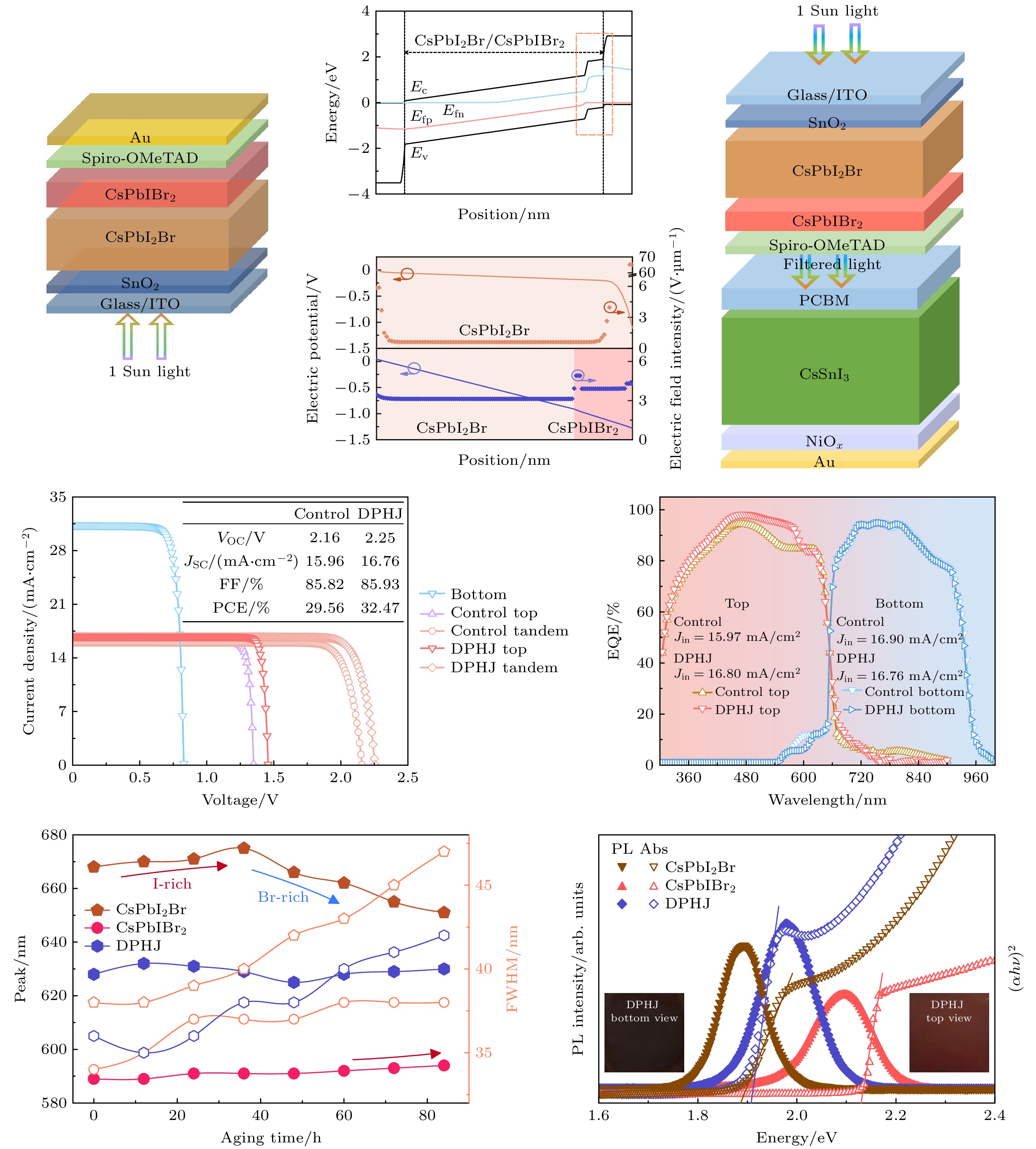
本文提出一种双吸收层钙钛矿异质结(dual-absorption-layer perovskite heterojunction, DPHJ)策略, 即通过将能带交错的II型钙钛矿异质结(p-pCsPbI2Br-CsPbIBr2)应用到全钙钛矿叠层太阳电池作为顶电池的双层结构的吸收层. 电池模拟结果表明, 与顶电池为单一吸收层CsPbI2Br的全钙钛矿叠层太阳电池相比, DPHJ的引入使得叠层太阳电池的开路电压显著增强(从2.16到2.25 V)、短路电流密度进一步提升(从15.96到16.76 mA⋅cm–2). 这主要归因于顶电池的双层结构的吸收层在CsPbI2Br/CsPbIBr2界面处形成能带弯曲, 诱导产生增强的内建电场, 促进载流子输运, 抑制了吸收层体内的非辐射复合. 由此基于DPHJ策略的叠层太阳电池可达到高的理论能量转换效率(32.47%). 进一步实验结果表明, 相比于单层CsPbI2Br(激子结合能E2 = 101.9 meV、电子-声子耦合强度$ {\gamma }_{\text{ac}}=1.2\times {10}^{-2},\; {\gamma }_{\text{LO}}=6.9\times {10}^{3} $), 双吸收层薄膜展现出更高的激子结合能(E2 = 110.7 meV)和更低的电子-声子耦合强度($ {\gamma }_{\text{ac}}=1.1\times {10}^{-2}, \;{\gamma }_{\text{LO}}=6.3\times {10}^{3} $), 表现出更强的光、热稳定性, 这有利于制备长效稳定的全钙钛矿叠层太阳电池.Organic cations in hybrid organic-inorganic perovskite solar cells are susceptible to decomposition under high temperatures and ultraviolet light, leading their power conversion efficiency (PCE) to decrease. All-inorganic perovskite solar cells exhibit both high PCE and superior photothermal stability, making them promising candidates for single-junction and tandem photovoltaic applications. The mixed-halide perovskite CsPbI2Br has received much attention as a top cell in semi-transparent and tandem solar cells due to its excellent thermal stability and suitable bandgap (1.90 eV). Although the PCE of CsPbI2Br-based solar cells is approaching its theoretical limit, the energy loss caused by non-radiative recombination remains a major barrier to further improving performance. This non-radiative recombination is mainly caused by inadequate band alignment between the absorption layer and the transport layer, resulting in the loss of open-circuit voltage (VOC) and decrease of short-circuit current density (JSC). Two-dimensional perovskite passivation formed through solution processing can mitigate interfacial recombination, but it can also impede efficient charge transport. Constructing three-dimensional perovskite structures not only provides an effective solution to these limitations but also enhances sunlight absorption and facilitates carrier transport. In this study, we propose a dual-absorption-layer perovskite heterojunction (DPHJ) strategy, which involves integrating a staggered type-II perovskite heterojunction (p-pCsPbI2Br-CsPbIBr2) into the absorption layer of the top cell in an all-perovskite tandem solar cell. The simulation result indicates that stacking a 100-nm-thick CsPbIBr2 layer atop a 300-nm-thick CsPbI2Br layer greatly enhances the PCE of the single-junction device from 19.46% to 22.29%. This improvement is mainly attributed to band bending at the CsPbI2Br/CsPbIBr2 interface, which enhances the built-in electric field, facilitates carrier transport, and suppresses non-radiative recombination within the absorption layer. Compared with the tandem solar cell utilizing a single-absorption-layer CsPbI2Br top cell, the DPHJ-based tandem solar cell significantly increases VOC from 2.16 to 2.25 V and JSC from 15.96 to 16.76 mA⋅cm–2. As a result, the DPHJ-based tandem solar cell achieves a high theoretical PCE of 32.47%. In addition, the DPHJ-based tandem solar cell exhibits a significantly enhanced external quantum efficiency in a wavelength range of 500–580 nm, which can be attributed to the band-edge absorption of CsPbIBr2. This enhanced absorption generates more photogenerated carriers, thereby significantly improving the JSC. The VOC and PCE values in this study exceed those experimentally reported values of current CsPbI2Br single-junction and all-perovskite tandem solar cells. Compared with the single-layer CsPbI2Br (E2 = 101.9 meV, electron-phonon coupling strength $ {\gamma _{{\text{ac}}}} = 1.2 \times {10^{ - 2}},{\text{ }}{\gamma _{{\text{LO}}}} = 6.9 \times {10^3} $), the double-absorption-layer film exhibits a high exciton binding energy (E2 = 110.7 meV) and reduced electron-phonon coupling strength ($ {\gamma _{{\text{ac}}}} = 1.1 \times {10^{ - 2}},{\text{ }}{\gamma _{{\text{LO}}}} = $$ 6.3 \times {10^3} $), which helps suppress phase segregation and enhance both optical and thermal stability, which is favorable for fabricating long-term stable all-perovskite tandem solar cells. This work provides new ideas and theoretical guidance for improving the efficiency and stability of all-perovskite tandem solar cells. In addition, it also proposes a universal design concept for optimizing absorption layers in all-perovskite multijunction cells, which is expected to further advance the research in this field.
-
Keywords:
- heterojunction /
- perovskite /
- tandem solar cell
[1] [2] [3] [4] [5] [6] [7] [8] [9] [10] [11] [12] [13] [14] [15] [16] [17] [18] [19] [20] [21] [22] [23] [24] [25] [26] [27] [28] [29] [30] [31] [32] [33] [34] [35] [36] [37] [38] [39] [40] [41] [42] [43] [44] [45] [46] [47] [48] [49] [50] [51] [52] [53] [54] [55] [56] [57] [58] [59] [60] [61] [62] [63] [64] [65] [66] [67] [68] [69] -
参数 CsPbI2Br CsPbIBr2 CsSnI3 NiOX PCBM SnO2 Spiro-OMeTAD 厚度/nm 300 100 800 30 30 50 50 受主浓度/cm–3 1×10¹⁵ 1×10¹⁵ 5×10¹⁶ 1×10¹⁵ 0 0 1×10¹⁹ 施主浓度/cm–3 0 0 0 0 5×10¹⁷ 1×10¹⁹ 0 带隙/eV 1.92 2.11 1.27 3.50 2 3.49 2.6 导带有效态密度/cm–3 5.1×10¹⁷ 1×10¹⁹ 1.58×10¹⁹ 2.8×10¹⁹ 1×10¹⁹ 4.36×10¹⁸ 2.5×10²⁰ 价带有效态密度/cm–3 1.8×10¹⁸ 1×10¹⁹ 1.47×10¹⁸ 1.8×10¹⁹ 1×10¹⁹ 2.52×10¹⁹ 2.5×10²⁰ 电子亲合能/eV 4.16 3.56 4.47 1.80 4.30 4.31 2.60 相对介电常数 7.43 20 10.59 10.70 4 9 3 电子迁移率/(cm2⋅V–1⋅s–1) 1.02×10⁵ 2.3×10³ 4.37 12 1×10⁻⁴ 240 2×10⁻⁴ 空穴迁移率/(cm2⋅V–1⋅s–1) 1.93×10⁴ 3.2×10² 4.37 25 1×10⁻² 25 2×10⁻⁴  下载: 导出CSV
Sample E1/meV E2/meV γac γLO ELO/meV CsPbI2Br 7.85 101.9 1.2×10⁻² 6.9×10³ 156.6 CsPbIBr2 9.25 85.8 1.8×10⁻³ 5.8×10³ 167.7 DPHJ 8.98 110.7 1.1×10⁻² 6.3×10³ 162.5
下载: 导出CSV
-
[1] [2] [3] [4] [5] [6] [7] [8] [9] [10] [11] [12] [13] [14] [15] [16] [17] [18] [19] [20] [21] [22] [23] [24] [25] [26] [27] [28] [29] [30] [31] [32] [33] [34] [35] [36] [37] [38] [39] [40] [41] [42] [43] [44] [45] [46] [47] [48] [49] [50] [51] [52] [53] [54] [55] [56] [57] [58] [59] [60] [61] [62] [63] [64] [65] [66] [67] [68] [69]


 下载:
下载:


计量
- 文章访问数: 983
- PDF下载量: 43
- 被引次数: 0