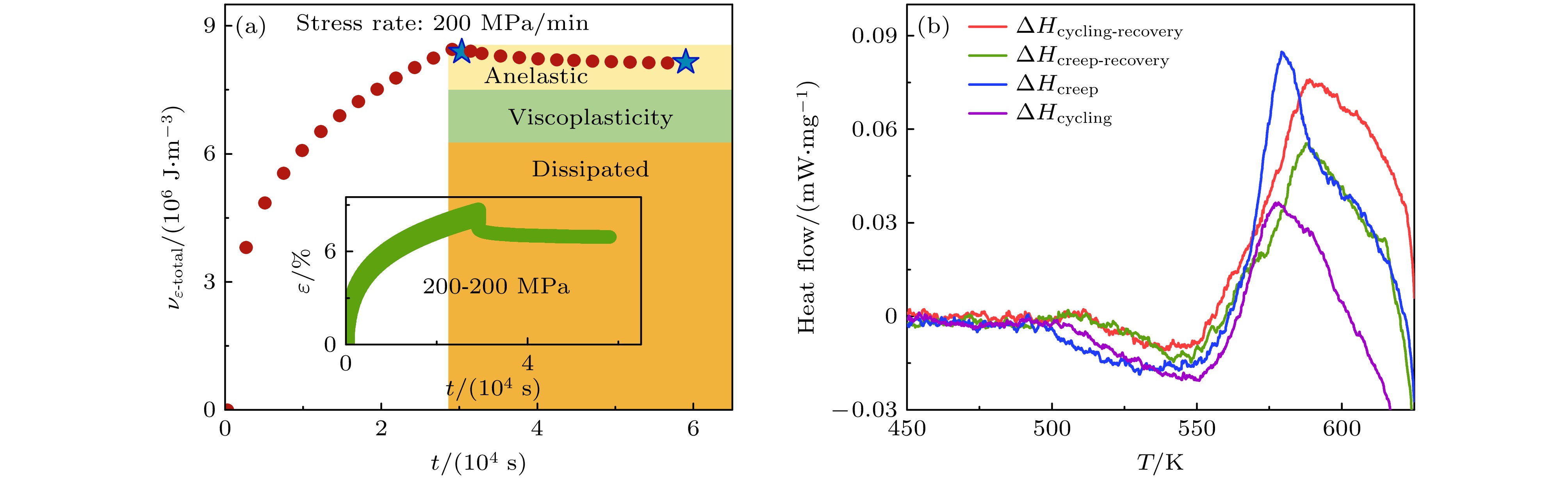
The engineering applications of amorphous alloys are largely restricted by structural relaxation. Notably, the dissipative component of cyclic loading dominates the thermodynamic energy in practical applications of amorphous alloys. Mechanical rejuvenation, achieved through cyclic loading, offers an effective solution to this problem. In this study, we systematically investigate the deformation characteristics and rejuvenation mechanism of Pd20Pt20Cu20Ni20P20 amorphous alloy under mechanical cycling using dynamic mechanical analysis (DMA). By employing a two-phase Kelvin model and continuous relaxation time spectrum, we elucidate the interplay between mechanical deformation and energy dissipation during cyclic loading. The experimental results demonstrate that the strain rate increases significantly with the intensity of mechanical cycling, indicating enhanced dynamic activity in the glassy matrix. At higher cycling intensities, anelastic deformation is promoted, activating a broader spectrum of defects and amplifying dynamic heterogeneity. Through differential scanning calorimetry (DSC), we establish a quantitative correlation between deformation and energetic state, revealing that rejuvenation originates from internal heating induced by anelastic strain. A comparative analysis with creep deformation reveals that mechanical cycling exhibits a superior rejuvenation potential, attributed to its ability to periodically excite multi-scale defect clusters and sustain non-equilibrium states. The key findings of this work include: 1) Deformation mechanism: Cyclic loading enhances atomic mobility and facilitates deformation unit activation; 2) Energy landscape: The enthalpy change (ΔH) measured by DSC provides a direct metric for rejuvenation efficiency; 3) Dynamic heterogeneity: Mechanical cycling broadens the relaxation time spectrum, reflecting increased dynamic heterogeneity.














 DownLoad:
