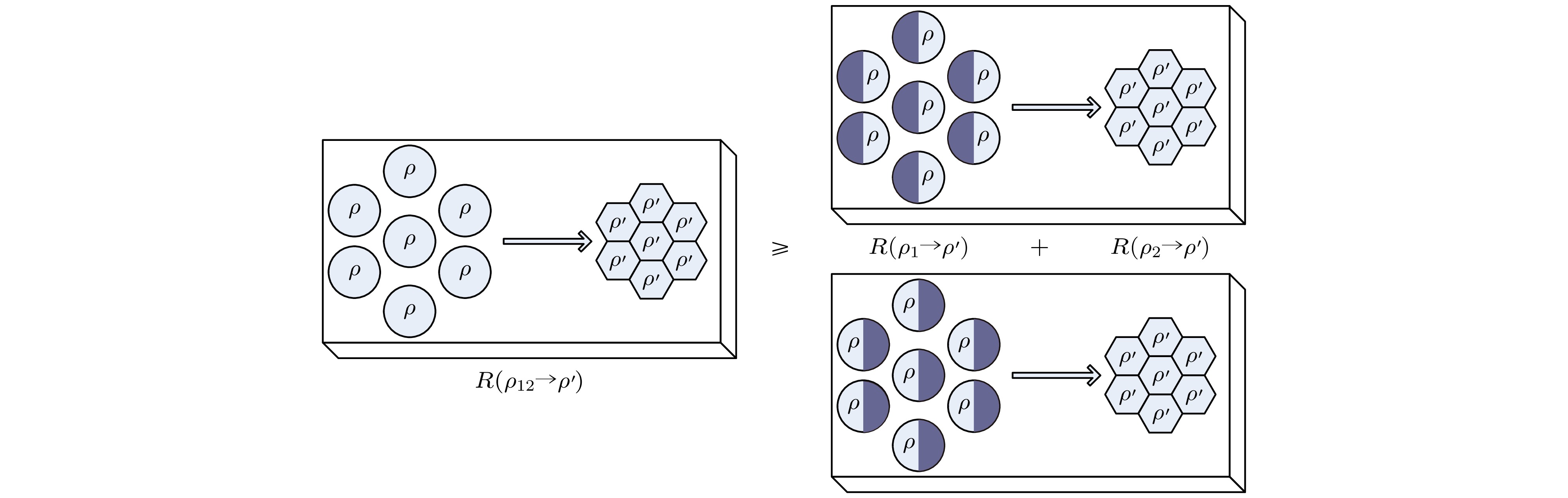
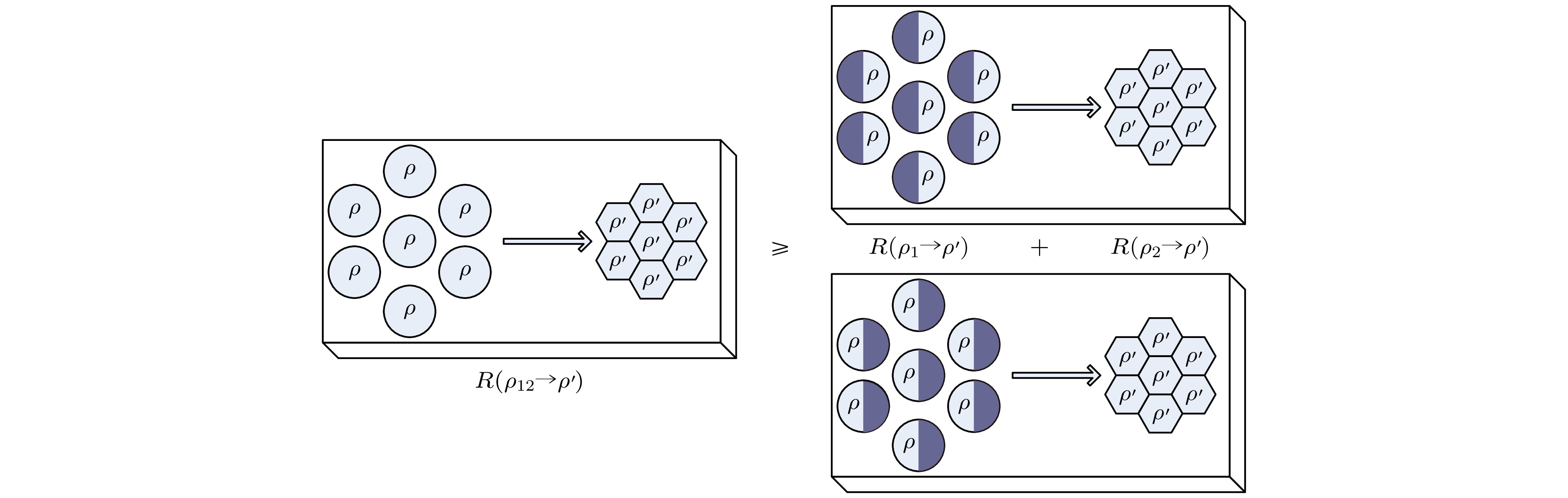
In quantum resource theories, manipulating and transforming resource states are often challenging due to the presence of noise. The resource manipulation process from a high resource state $ {\boldsymbol \rho} $ to a low resource state $ {\boldsymbol \rho} ' $ involves asymptotic multiple state replicas, which can be considered as overcoming this problem. Here, the asymptomatic transformation rate $ R\left( {{\boldsymbol \rho} \to {\boldsymbol \rho} '} \right) $ can characterize the corresponding quantum manipulation power, and can be calculated as the ratio of the copy number of initial states to the copy number of target states. Generally, the precise computations of asymptotic transformation rates are challenging, so it is important to establish rigorous and computable boundaries for them. Recently, Ganardi et al. have shown that the transformation rate to any pure state is superadditive for the distillable entanglement. However, it remains a question whether the transformation rate to any noise state is also superadditive in the general resource theory. Firstly, we study the general superadditive inequality satisfied by the transformation rate $ R\left( {{\boldsymbol \rho} \to {\boldsymbol \rho} '} \right) $ of any noise state $ {\boldsymbol \rho} ' $. In any multiple quantum resource theory, we also show that the bipartite asymptomatic transformation rate obeys a distributed relationship: when $ \alpha \geqslant 1 $, $ {R^\alpha }\left( {{\boldsymbol \rho} \to {\boldsymbol \rho} '} \right) $ satisfies monogamy relationship. Using similar methods, we demonstrate that both the marginal asymptotic transformation rate and marginal catalytic transformation rate satisfies these relationships. As a byproduct, we show an equivalence among the asymptomatic transformation rate, marginal asymptotic transformations, and marginal catalytic transformations under some restrictions. Here marginal asymptotic transformations and marginal catalytic transformations are special asymptotic transformations, where the initial state can be reduced into target state at a nonzero rate. These inequality relationships impose a new constraint on the quantum resource distribution and trade off among subsystems. Recently, reversible quantum resource manipulations have been studied, and it is conjectured that transformations can be reversibly executed in an asymptotic regime. In the future, we will explore a conclusive proof of this conjecture and then study the distributions of these reversible manipulations.














 DownLoad: