













-
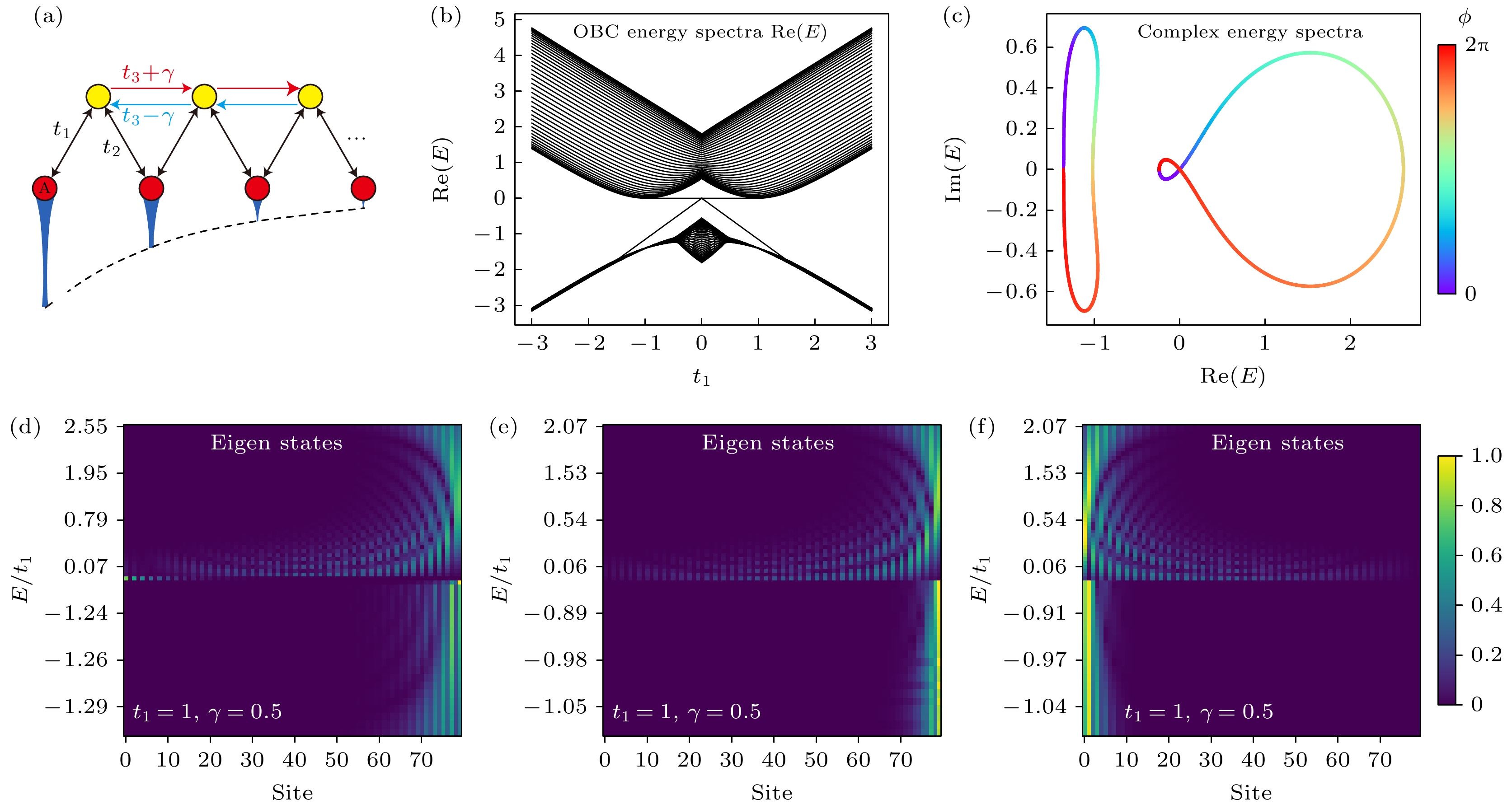
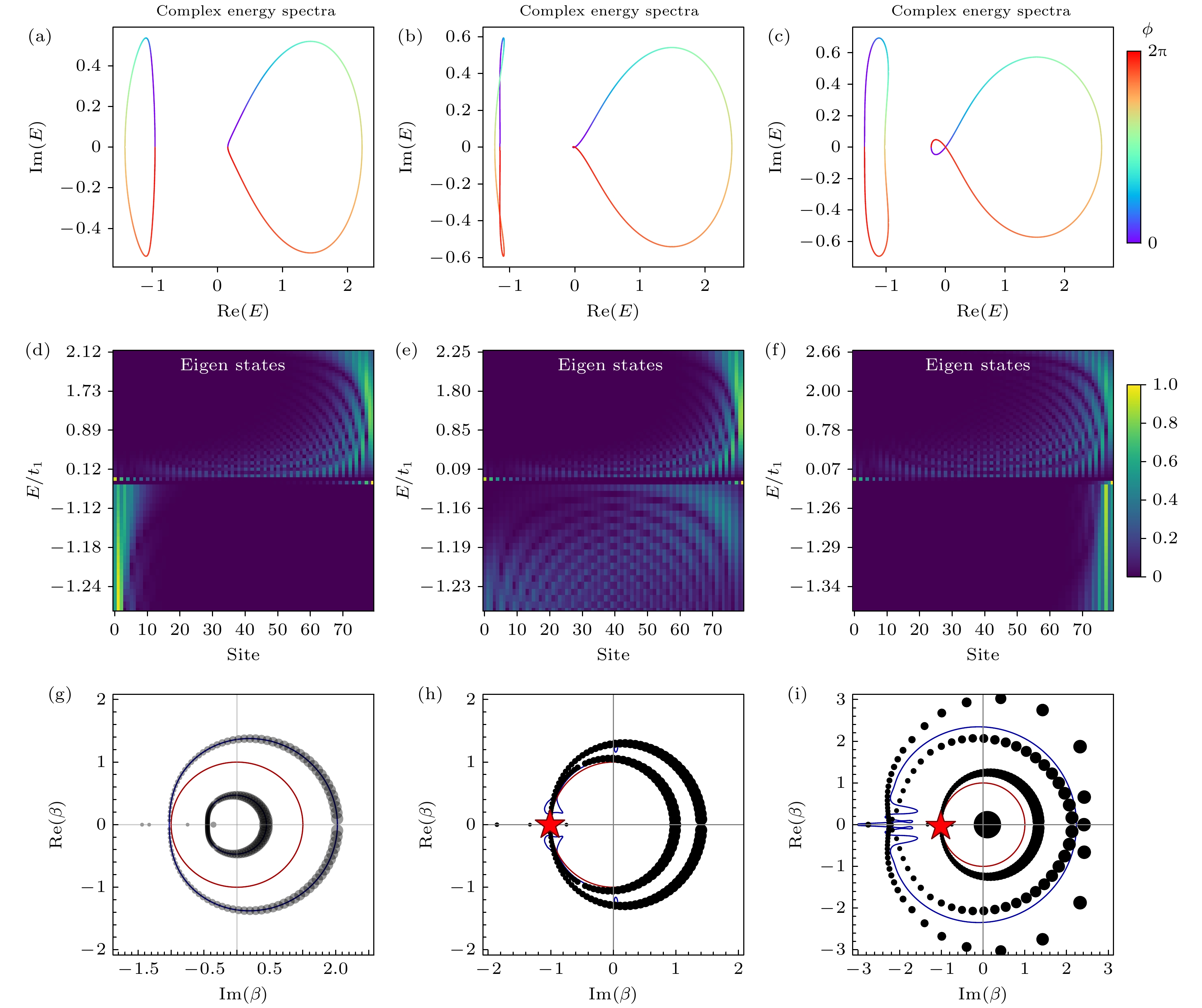
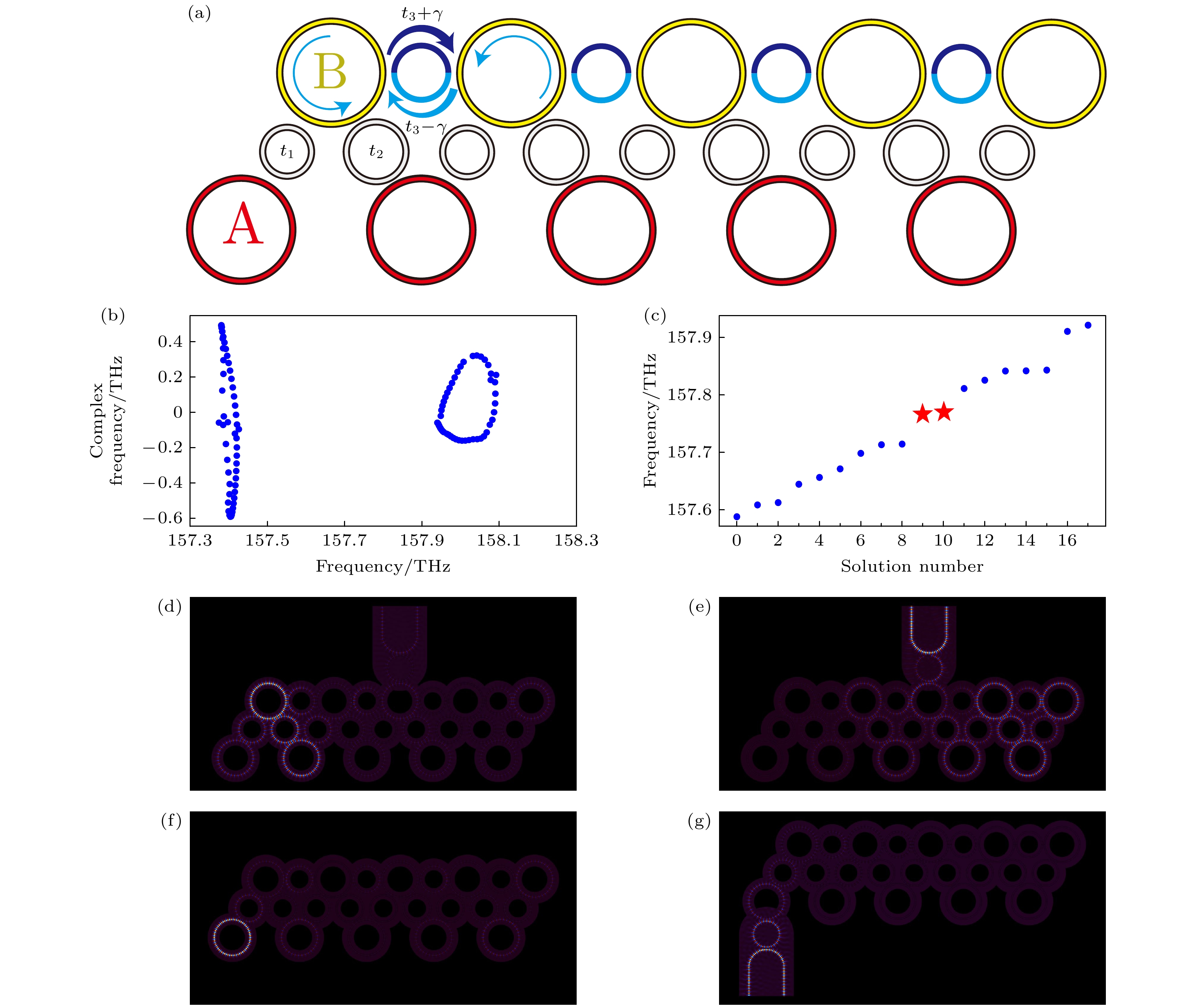
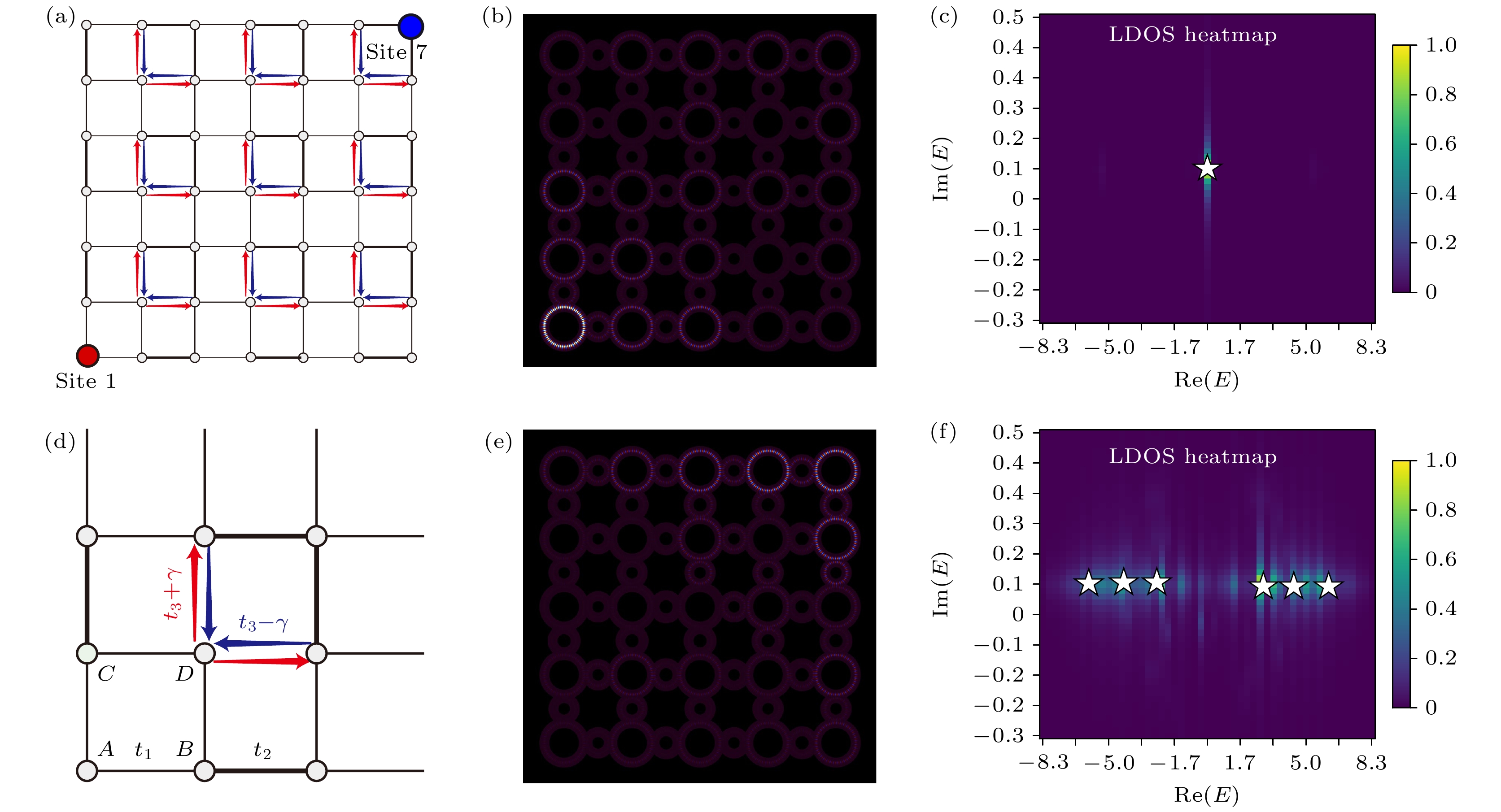
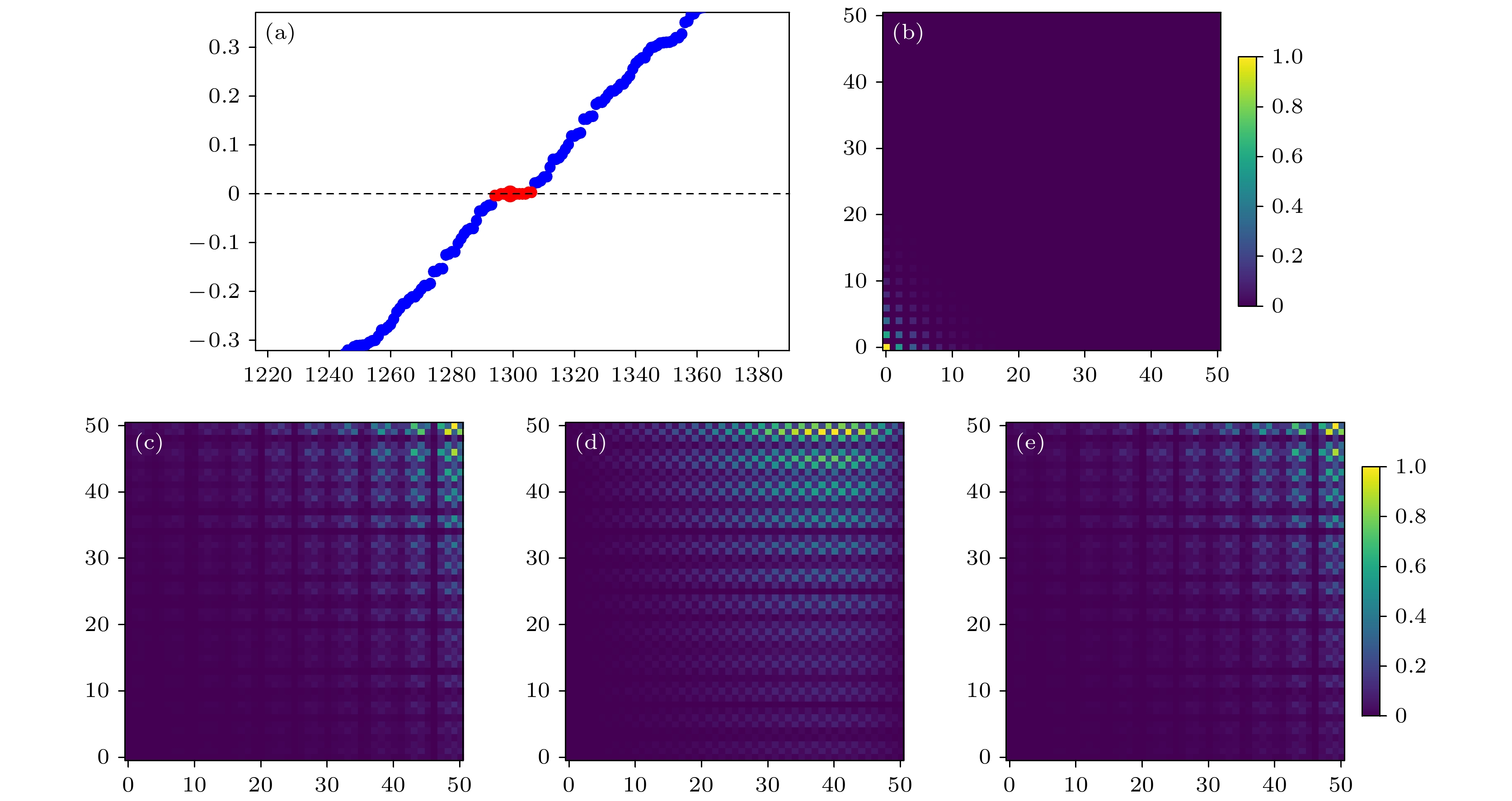
Topologically protected waveguides have aroused increasing interest due to their robustness against disorder and defects. In parallel, the advent of non-Hermitian physics with its inherent gain-and-loss mechanisms has introduced new tools for manipulating wave localization and transport. However, most attempts to combine non-Hermitian effects with topological systems uniformly impose the non-Hermitian skin effect (NHSE) on all modes, without selectivity targeting topological states. In this work, we propose a scheme thatachieves topologically selective NHSE by combining sub-symmetry-protected boundary modes with long-range non-reciprocal couplings. In an improved Su–Schrieffer–Heeger (SSH) chain, we analytically demonstrate that robust zero-energy edge modes can be preserved even in spectra filled with bulk states, while selectively applying the NHSE to the trivial bulk states to achieve the spatial separation between topological state and bulk state. By adjusting the long-range couplings a non-Hermitian phase transition can be observed in the complex energy spectrum: it transitions from a closed loop (circle) to an open arc, and ultimately to a reversely coiled loop. These transitions correspond respectively to a leftward NHSE, the disappearance of the NHSE, and a rightward NHSE. According to the calculations of the generalized Brillouin zone (GBZ), we confirm this transition by observing the GBZ passing through the unit circle, indicating a change in the direction of NHSE.We further extend our model to a two-dimensional higher-order SSH lattice, where selective non-Hermitian modulation enables clear spatial separation between topological corner states and bulk modes. To quantify this, we compute the local density of states (LDOS) in the complex energy plane for site 0 (a topologically localized corner) and site 288 (a region exhibiting NHSE). The comparison of LDOS between the two sites reveals that the topological states are primarily localized at site 0, while the bulk states affected by NHSE accumulate at site 288.To validate the theoretical predictions, we perform finite-element simulations of optical resonator arrays by using whispering-gallery modes. By adjusting the coupling distances and incorporating gain/loss through refractive index engineering, we replicate the modified SSH model and confirm the selective localization of topological and bulk modes.Our results provide a robust method for selectively exciting and spatially controlling the topological states in non-Hermitian systems, and also lay a foundation for future low-crosstalk high-stability topological photonic devices.
[1] [2] [3] [4] [5] [6] [7] [8] [9] [10] [11] [12] [13] [14] [15] [16] [17] [18] [19] [20] [21] [22] [23] [24] [25] [26] [27] [28] [29] [30] [31] [32] [33] [34] [35] [36] [37] [38] [39] [40] [41] [42] [43] [44] [45] [46] -
-
[1] [2] [3] [4] [5] [6] [7] [8] [9] [10] [11] [12] [13] [14] [15] [16] [17] [18] [19] [20] [21] [22] [23] [24] [25] [26] [27] [28] [29] [30] [31] [32] [33] [34] [35] [36] [37] [38] [39] [40] [41] [42] [43] [44] [45] [46] -
[1] BAO Xixi, GUO Gangfeng, TAN Lei, LIU Wuming. Topological phase induced by long range hopping in non-Hermitian Floquet system. Acta Physica Sinica, 2025, 74(17): . doi: 10.7498/aps.74.20250599 [2] Liu En-Ke. Coupling between magnetism and topology: From fundamental physics to topological magneto-electronics. Acta Physica Sinica, 2024, 73(1): 017103. doi: 10.7498/aps.73.20231711 [3] Gu Yan, Lu Zhan-Peng. Localization transition in non-Hermitian coupled chain. Acta Physica Sinica, 2024, 73(19): 197101. doi: 10.7498/aps.73.20240976 [4] Huang Ze-Xin, Sheng Zong-Qiang, Cheng Le-Le, Cao San-Zhu, Chen Hua-Jun, Wu Hong-Wei. Steering non-Hermitian skin states by engineering interface in 1D nonreciprocal acoustic crystal. Acta Physica Sinica, 2024, 73(21): 214301. doi: 10.7498/aps.73.20241087 [5] Wang Zi-Yao, Chen Fu-Jia, Xi Xiang, Gao Zhen, Yang Yi-Hao. Non-reciprocal topological photonics. Acta Physica Sinica, 2024, 73(6): 064201. doi: 10.7498/aps.73.20231850 [6] Wang Zhen-Yu, Li Zhi-Xiong, Yuan Huai-Yang, Zhang Zhi-Zhi, Cao Yun-Shan, Yan Peng. Topological states and quantum effects in magnonics. Acta Physica Sinica, 2023, 72(5): 057503. doi: 10.7498/aps.72.20221997 [7] Xu Can-Hong, Xu Zhi-Cong, Zhou Zi-Yu, Cheng En-Hong, Lang Li-Jun. Electrical circuit simulation of non-Hermitian lattice models. Acta Physica Sinica, 2023, 72(20): 200301. doi: 10.7498/aps.72.20230914 [8] Yang Yan-Li, Duan Zhi-Lei, Xue Hai-Bin. Edge states and skin effect dependent electron transport properties of non-Hermitian Su-Schrieffer-Heeger chain. Acta Physica Sinica, 2023, 72(24): 247301. doi: 10.7498/aps.72.20231286 [9] Li Jia-Rui, Wang Zi-An, Xu Tong-Tong, Zhang Lian-Lian, Gong Wei-Jiang. Topological properties of the one-dimensional ${\cal {PT}}$ -symmetric non-Hermitian spin-orbit-coupled Su-Schrieffer-Heeger model. Acta Physica Sinica, 2022, 71(17): 177302. doi: 10.7498/aps.71.20220796[10] Cheng En-Hong, Lang Li-Jun. Electrical circuit simulation of nonreciprocal Aubry-André models. Acta Physica Sinica, 2022, 71(16): 160301. doi: 10.7498/aps.71.20220219 [11] Hou Bo, Zeng Qi-Bo. Non-Hermitian mosaic dimerized lattices. Acta Physica Sinica, 2022, 71(13): 130302. doi: 10.7498/aps.71.20220890 [12] Liu Jia-Lin, Pang Ting-Fang, Yang Xiao-Sen, Wang Zheng-Ling. Skin effect in disordered non-Hermitian Su-Schrieffer-Heeger. Acta Physica Sinica, 2022, 71(22): 227402. doi: 10.7498/aps.71.20221151 [13] Chen Shu-Yue, Jiang Chuang, Ke Shao-Lin, Wang Bing, Lu Pei-Xiang. Suppression of non-Hermitian skin effect via Aharonov-Bohm cage. Acta Physica Sinica, 2022, 71(17): 174201. doi: 10.7498/aps.71.20220978 [14] Deng Tian-Shu. Non-Hermitian skin effect in a domain-wall system. Acta Physica Sinica, 2022, 71(17): 170306. doi: 10.7498/aps.71.20221087 [15] Sun Kong-Hao, Yi Wei. Dynamics of non-Hermitian local topological marker. Acta Physica Sinica, 2021, 70(23): 230309. doi: 10.7498/aps.70.20211576 [16] Hu Yu-Min, Song Fei, Wang Zhong. Generalized Brillouin zone and non-Hermitian band theory. Acta Physica Sinica, 2021, 70(23): 230307. doi: 10.7498/aps.70.20211908 [17] Liao Qing-Hong, Deng Wei-Can, Wen Jian, Zhou Nan-Run, Liu Nian-Hua. Phonon blockade induced by a non-Hermitian Hamiltonian in a nanomechanical resonator coupled with a qubit. Acta Physica Sinica, 2019, 68(11): 114203. doi: 10.7498/aps.68.20182263 [18] Xu Nan, Zhang Yan. Topological edge states with skin effect in a trimerized non-Hermitian lattice. Acta Physica Sinica, 2019, 68(10): 104206. doi: 10.7498/aps.68.20190112 [19] Mei Yu-Han, Shao Yue, Hang Zhi-Hong. Microwave experimental platform to demonstrate topology physics based on tight-binding model. Acta Physica Sinica, 2019, 68(22): 227803. doi: 10.7498/aps.68.20191452 [20] Wang Hong-Fei, Xie Bi-Ye, Zhan Peng, Lu Ming-Hui, Chen Yan-Feng. Research progress of topological photonics. Acta Physica Sinica, 2019, 68(22): 224206. doi: 10.7498/aps.68.20191437

 DownLoad:

Catalog
Metrics
- Abstract views: 1406
- PDF Downloads: 138
- Cited By: 0